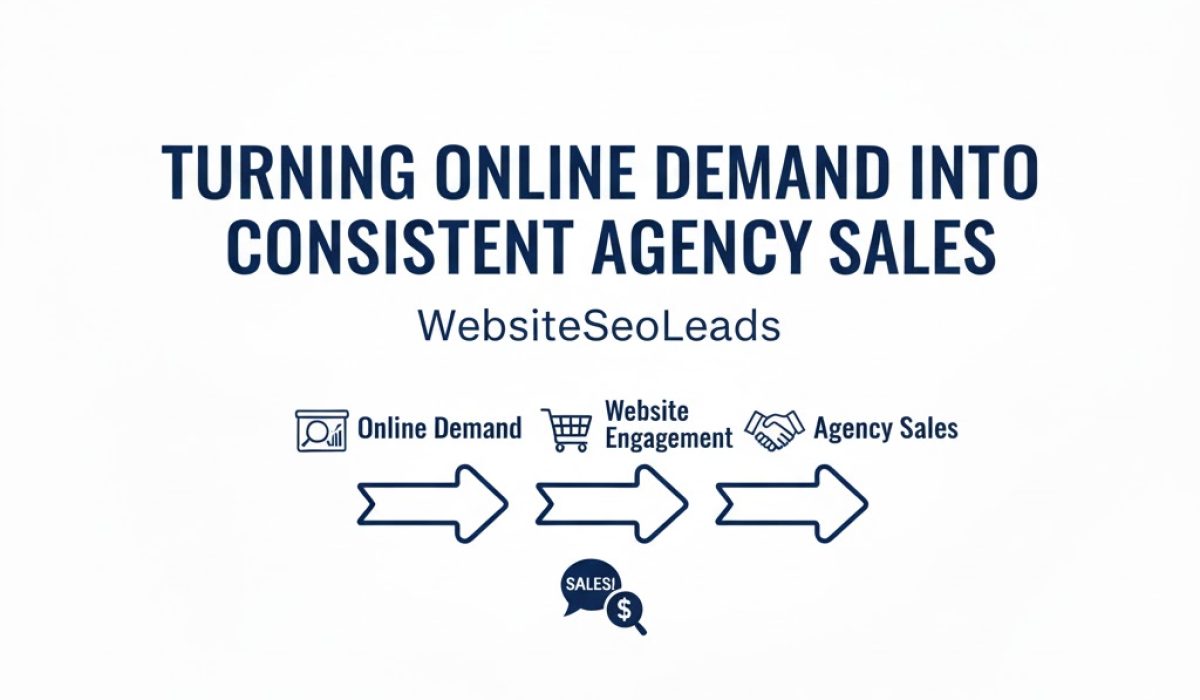
Digital agencies today are surrounded by demand. Businesses are constantly searching online for SEO services, social media marketing, web development, PPC management, and reputation solutions. Yet despite this visible demand, many agencies struggle with unpredictable revenue, inconsistent deal flow, and reliance on referrals or manual outreach. The gap is not a lack of interest, but the inability to systematically convert online demand into consistent agency sales.
Turning demand into revenue requires more than traffic or visibility. It requires structure, systems, and a clear understanding of how prospects move from awareness to decision. Agencies that master this transition build sustainable growth engines rather than chasing one-off opportunities.
Understanding Online Demand in the Agency Market
Online demand refers to the active intent shown by businesses searching for digital marketing and web services. This demand appears through search queries, social interactions, content engagement, and paid advertising signals. However, demand alone does not guarantee conversions.
Many agencies attract website visitors or inquiries but fail to convert them into qualified sales conversations. This usually happens because demand is not captured properly, followed up consistently, or filtered effectively.
High-performing agencies treat online demand as raw material that must be processed through a structured system before it becomes revenue.
Why Agencies Struggle to Convert Demand Into Sales
One of the most common challenges agencies face is fragmentation. Traffic generation, lead capture, follow-up, and sales often operate as disconnected efforts. Without integration, leads fall through the cracks or receive delayed responses.
Another issue is lack of qualification. Agencies that respond to every inquiry without filtering waste time on low-intent prospects. This creates frustration for sales teams and slows down revenue growth.
Finally, many agencies rely too heavily on manual processes. Manual follow-ups, spreadsheets, and inbox-based lead management cannot scale with growing demand.
Building a Demand-to-Sales Framework
To convert online demand into consistent agency sales, a structured framework is essential. This framework aligns marketing, automation, and sales into one cohesive flow.
Capturing Demand at the Right Moment
The first step is capturing demand when intent is highest. This means placing optimized landing pages, lead forms, and calls to action where potential clients are actively searching or engaging.
Instead of generic contact forms, agencies benefit from service-specific or industry-focused entry points. These help attract prospects with clearer intent and better fit.
Lead capture should also integrate seamlessly with internal systems so that every inquiry is tracked and actionable.
Structuring Lead Qualification Early
Not all demand is equal. High-growth agencies implement qualification mechanisms early in the funnel. This can include targeted form questions, service selection options, budget indicators, or automated scoring models.
Early qualification ensures that sales teams focus on prospects who are more likely to convert, improving close rates and reducing wasted effort.
This approach also enhances the client experience by guiding prospects toward the most relevant solution instead of generic sales conversations.
Speed and Consistency in Follow-Up
Response time plays a critical role in converting demand into sales. Studies consistently show that leads contacted quickly are far more likely to convert.
Automated follow-up systems ensure that every lead receives immediate acknowledgment and ongoing nurturing. Email sequences, reminders, and notifications create consistency without relying on manual intervention.
Agencies that respond late or inconsistently often lose prospects to competitors who act faster.
Aligning Marketing and Sales for Predictable Results
One of the biggest barriers to consistent sales is misalignment between marketing and sales teams. Marketing may focus on generating leads, while sales struggles with quality or context.
A unified demand-to-sales system shares data across teams. Sales can see where leads came from, what services they viewed, and how they engaged before reaching out. This context allows for more personalized and effective conversations.
Alignment also enables better feedback loops. Sales insights can be used to refine targeting, messaging, and campaigns, improving lead quality over time.
Leveraging Automation to Scale Conversion
Automation is essential for turning demand into consistent sales at scale. As demand increases, manual processes quickly become bottlenecks.
Automation handles repetitive tasks such as lead routing, follow-up scheduling, pipeline updates, and reminders. This allows sales teams to focus on closing deals rather than managing workflows.
Tools and platforms like WebsiteSeoLeads help agencies bridge the gap between lead acquisition and structured sales processes by connecting demand sources with automated systems designed for conversion.
Creating Predictability Through Data and Tracking
Consistency in sales comes from visibility. Agencies that track key metrics gain control over their growth.
Important metrics include lead source performance, response time, conversion rates, deal velocity, and client acquisition cost. These insights reveal where demand is converting and where it is leaking.
With data-driven insights, agencies can make informed decisions instead of relying on assumptions. Over time, this leads to predictable pipelines and stable revenue.
Optimizing the Sales Journey
Turning demand into sales does not stop at lead capture. The entire sales journey must be optimized.
This includes clear value propositions, transparent pricing frameworks, structured discovery calls, and defined next steps. Agencies that standardize their sales process reduce friction and improve conversion rates.
Consistency in sales messaging also builds trust. Prospects feel more confident when interactions feel professional, timely, and relevant to their needs.
Reducing Dependency on Referrals and Cold Outreach
While referrals and outreach can support growth, they should not be the foundation of an agency’s revenue. These methods are unpredictable and difficult to scale.
By converting online demand into consistent sales, agencies reduce dependency on external factors. Inbound systems work continuously, even when the team is focused on delivery.
This shift allows agencies to grow without increasing stress or workload proportionally.
Long-Term Benefits of a Demand-Driven Sales System
Agencies that successfully turn online demand into consistent sales experience several long-term benefits. Revenue becomes more stable, making planning and hiring decisions easier.
Sales teams become more efficient, focusing on qualified prospects instead of chasing uninterested leads. Marketing efforts become more measurable, with clear attribution to revenue.
Ultimately, the agency becomes a scalable business rather than a founder-dependent operation.
Platforms such as WebsiteSeoLeads support this evolution by enabling agencies to structure demand, automate follow-ups, and maintain visibility across the entire acquisition lifecycle.
Conclusion
Online demand for digital services continues to grow, but only agencies with the right systems can fully capitalize on it. Turning demand into consistent agency sales requires intentional design, automation, and alignment between marketing and sales.
Agencies that invest in structured frameworks gain predictability, efficiency, and long-term growth advantages. In an increasingly competitive market, the ability to convert demand into revenue is not just a skill, but a strategic necessity.