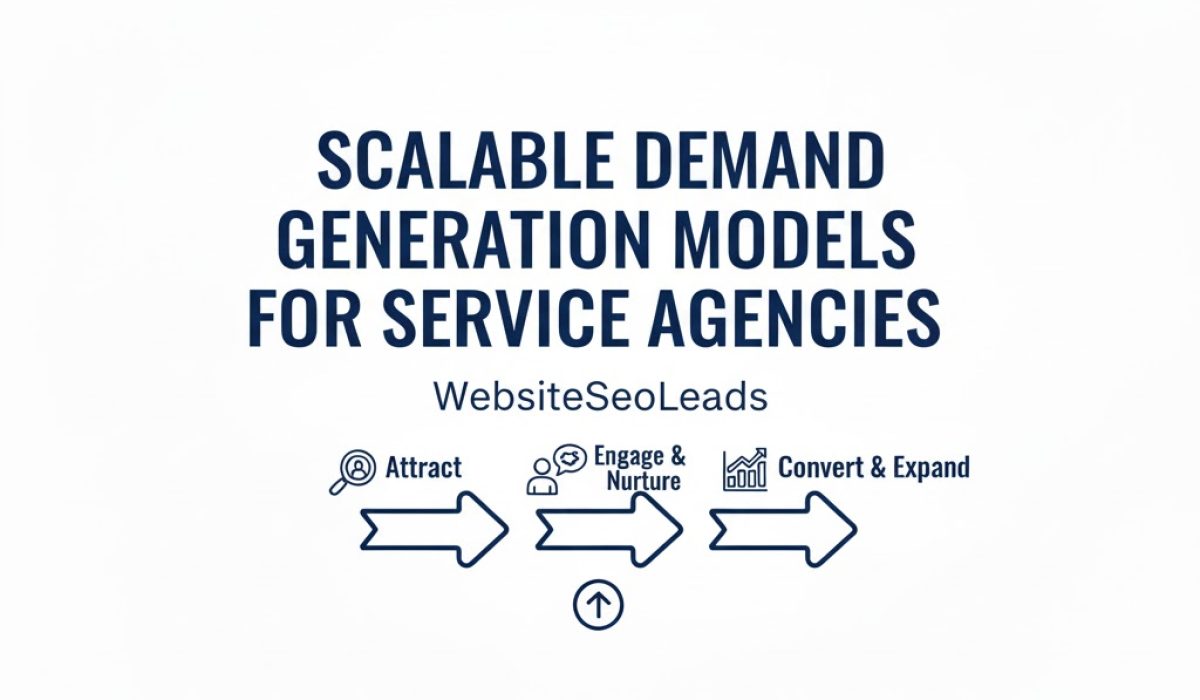
Service agencies today face a very different growth environment than they did a few years ago. Competition has increased, client expectations have evolved, and traditional outreach methods like cold calling or manual prospecting are delivering diminishing returns. To grow consistently, agencies need scalable demand generation models that create predictable pipelines without exhausting internal teams.
Demand generation is not just about leads. It is about building a system that attracts, qualifies, nurtures, and converts prospects at scale. For service agencies offering SEO, web design, PPC, SMM, or reputation management, this approach is no longer optional. It is the foundation of sustainable growth.
Understanding Demand Generation for Service Agencies
Demand generation focuses on creating awareness, trust, and intent before a prospect ever speaks to a sales representative. Unlike short-term lead tactics, it builds long-term visibility and authority while still delivering measurable results.
For service agencies, demand generation bridges the gap between marketing and sales. It ensures that prospects understand the value of the service, recognize the agency as a credible solution, and enter the sales funnel already educated.
Scalability comes from systems. When outreach depends entirely on human effort, growth hits a ceiling. Scalable models rely on automation, content, data, and optimized workflows that continue working even when the team is offline.
Why Traditional Lead Generation No Longer Scales
Many agencies still depend on manual outreach, purchased contact lists, or inconsistent referral flows. While these methods can produce results in the short term, they struggle to scale.
Manual outreach consumes time and energy, often with low response rates. Cold calling and cold emailing require constant effort and rarely build brand authority. Referral-based growth, while valuable, is unpredictable and difficult to control.
Scalable demand generation models solve these problems by creating repeatable processes. They allow agencies to forecast growth, measure performance, and adjust strategies based on data rather than guesswork.
Core Components of a Scalable Demand Generation Model
A successful demand generation model for service agencies rests on several interconnected components.
First is audience clarity. Agencies must clearly define who they serve, what problems they solve, and what differentiates them from competitors. Without this clarity, even the most advanced tools will underperform.
Second is content alignment. Content should address real client pain points at every stage of the buying journey. Educational blogs, comparison guides, case studies, and solution-focused pages all play a role in nurturing demand.
Third is traffic acquisition. Demand generation relies on consistent traffic from search engines, paid advertising, partnerships, and social platforms. The focus should be on channels that deliver high-intent prospects rather than vanity metrics.
Fourth is lead capture and qualification. Scalable systems use forms, landing pages, and gated assets to collect prospect data while filtering out low-quality inquiries.
Finally, automation and follow-up tie everything together. Automated workflows ensure that no lead is ignored and that each prospect receives relevant communication based on behavior and intent.
Inbound-Driven Demand Generation Models
Inbound demand generation remains one of the most effective and scalable approaches for service agencies. It leverages search intent and educational content to attract prospects who are already looking for solutions.
Search engine optimization plays a central role in this model. By targeting service-specific keywords and problem-based queries, agencies can attract visitors with high purchase intent. Over time, this creates a steady flow of inbound inquiries without ongoing ad spend.
Content marketing supports this approach by building authority. Well-structured blogs, whitepapers, and service pages help prospects understand complex services and build trust before the first conversation.
Inbound models scale because content continues to generate demand long after it is published. When combined with lead capture tools and CRM integration, inbound traffic becomes a predictable acquisition channel.
Outbound-Enhanced Demand Generation Models
While inbound strategies attract demand, outbound tactics can amplify results when executed strategically. The key difference in scalable outbound models is targeting and personalization.
Instead of mass outreach, modern demand generation uses data-driven targeting. Agencies focus on specific industries, company sizes, or decision-maker roles, ensuring that outreach efforts reach relevant prospects.
Automation platforms allow agencies to personalize messaging at scale. Behavioral triggers, segmentation, and follow-up sequences ensure consistent communication without manual effort.
When outbound efforts are aligned with inbound content and brand messaging, they reinforce each other and accelerate pipeline growth.
Automation as the Backbone of Scalability
Automation is what transforms demand generation from a manual process into a scalable system. For service agencies, automation impacts lead capture, qualification, nurturing, and follow-up.
Automated lead scoring helps teams focus on prospects most likely to convert. Email workflows educate leads over time, reducing the burden on sales teams. CRM systems centralize data, ensuring visibility across marketing and sales.
Platforms like WebsiteSeoLeads help agencies streamline this process by connecting demand generation efforts with structured lead delivery and management. Instead of chasing disconnected leads, agencies can focus on closing opportunities that align with their services.
Data-Driven Optimization for Long-Term Growth
Scalable demand generation models rely on continuous optimization. Agencies must track performance metrics such as traffic quality, conversion rates, lead-to-client ratios, and acquisition costs.
Data reveals which channels generate the most valuable clients and which messages resonate with decision-makers. Over time, agencies can refine targeting, content, and automation workflows to improve efficiency.
This data-first approach reduces guesswork and allows agencies to scale confidently. Rather than relying on sporadic wins, growth becomes measurable and repeatable.
Building Trust Through Authority and Proof
Service agencies sell expertise, not physical products. Trust is therefore central to demand generation success. Scalable models incorporate authority-building elements such as case studies, testimonials, and industry insights.
Social proof reassures prospects that the agency can deliver results. Educational content demonstrates expertise and positions the agency as a reliable advisor rather than just another vendor.
When authority is built into the demand generation system, sales cycles shorten and conversion rates improve.
Integrating Lead Sources Into a Unified System
One of the biggest challenges agencies face is managing multiple lead sources. Traffic may come from SEO, ads, referrals, or third-party platforms, but without integration, leads become fragmented.
Scalable demand generation models unify all sources into a single system. CRM integration ensures that every lead is tracked, nurtured, and followed up appropriately.
Using structured platforms such as WebsiteSeoLeads allows agencies to maintain consistency while scaling lead volume. This prevents missed opportunities and improves overall efficiency.
The Long-Term Value of Scalable Demand Generation
Scalable demand generation models do more than generate leads. They build brand equity, improve forecasting, and reduce dependency on unpredictable tactics.
For service agencies, this approach creates stability. Teams can plan growth, hire strategically, and invest confidently in expansion. Instead of reacting to market changes, agencies with strong demand generation systems stay ahead of competitors.
Over time, the compounding effect of content, automation, and optimization creates a competitive advantage that is difficult to replicate.
Conclusion
Scalable demand generation models are essential for service agencies that want consistent, predictable growth. By focusing on systems rather than isolated tactics, agencies can attract the right clients, nurture trust, and convert demand efficiently.
The combination of inbound strategies, targeted outbound efforts, automation, and data-driven optimization forms the foundation of long-term success. Agencies that invest in these models today position themselves for sustainable growth in an increasingly competitive market.
Demand generation is no longer about working harder. It is about building smarter systems that work continuously, scale effortlessly, and support the agency’s vision for growth.