
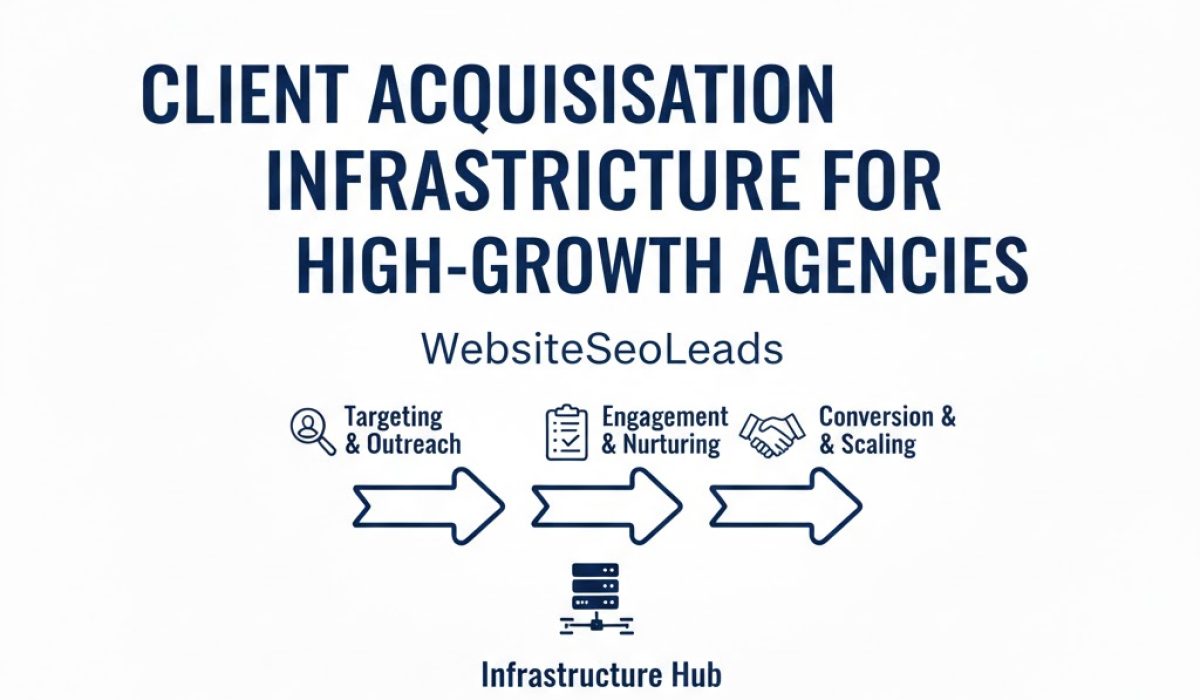
For digital agencies aiming to scale beyond inconsistent projects and referral-based growth, client acquisition is no longer about isolated tactics. High-growth agencies operate on a structured, repeatable system that continuously attracts, nurtures, and converts prospects. This system is known as client acquisition infrastructure. Unlike one-off campaigns or manual outreach, a strong infrastructure creates predictable revenue and long-term stability.
As competition increases across SEO, web development, PPC, and social media services, agencies without a clear acquisition framework struggle with fluctuating income, wasted ad spend, and unqualified leads. High-performing agencies, on the other hand, invest early in building systems that work even when the team is not actively selling.
Understanding Client Acquisition Infrastructure
Client acquisition infrastructure refers to the combination of tools, processes, data, and automation that work together to generate qualified prospects and convert them into paying clients. It is not a single software or channel. Instead, it is a complete ecosystem designed to support growth at scale.
This infrastructure typically includes lead sources, landing pages, CRM systems, automated follow-ups, qualification workflows, analytics, and conversion optimization strategies. When these components are aligned, agencies reduce manual work while increasing close rates and client lifetime value.
Why High-Growth Agencies Focus on Systems, Not Hustle
Early-stage agencies often rely on cold emails, networking, or manual outreach. While these methods may work temporarily, they are not sustainable at scale. High-growth agencies shift their mindset from chasing clients to attracting them through structured systems.
A well-built acquisition infrastructure ensures that leads are consistently entering the pipeline, being nurtured automatically, and handed off to sales teams at the right moment. This reduces burnout, shortens sales cycles, and creates measurable growth.
Agencies that depend solely on hustle face unpredictable results. Agencies that invest in infrastructure build assets that compound over time.
Core Components of a Scalable Client Acquisition Infrastructure
A successful infrastructure is built on several interconnected components. Each plays a critical role in turning interest into revenue.
Targeted Lead Generation Channels
High-growth agencies focus on lead channels that align with their ideal client profile. These may include inbound SEO traffic, paid search, paid social, partner referrals, or specialized lead platforms. The goal is not volume, but relevance.
Qualified leads convert faster and require less persuasion. This is why agencies prioritize intent-based lead sources that attract businesses already looking for solutions.
Conversion-Focused Landing Pages
Traffic without conversion is wasted opportunity. Dedicated landing pages designed around specific services, industries, or pain points dramatically increase lead quality.
These pages clearly communicate value, address objections, and guide visitors toward a single action. They also integrate seamlessly with CRM and automation tools to ensure no lead is lost.
CRM and Lead Management Systems
A CRM is the backbone of any acquisition infrastructure. It stores lead data, tracks interactions, and provides visibility into the sales pipeline. Without a CRM, agencies struggle to follow up consistently and analyze performance.
Modern CRMs allow segmentation, tagging, pipeline tracking, and reporting. This enables agencies to understand which channels produce the best clients and where improvements are needed.
Automated Follow-Up and Nurturing
Speed and consistency are critical in client acquisition. Automated follow-up ensures that every lead receives timely communication, even outside business hours.
Email sequences, SMS reminders, and retargeting workflows keep prospects engaged until they are ready to convert. Automation also reduces reliance on manual sales efforts, allowing teams to focus on high-value conversations.
Qualification and Filtering Mechanisms
Not every lead is a good fit. High-growth agencies implement qualification frameworks to filter out low-quality prospects early.
This may include form questions, scoring rules, or automated decision trees. By qualifying leads upfront, agencies protect their time and maintain high service standards.
The Role of Data and Optimization
Infrastructure without data is guesswork. High-performing agencies continuously analyze metrics such as cost per lead, conversion rates, response times, and close rates.
This data-driven approach allows agencies to refine messaging, adjust targeting, and improve workflows. Over time, small optimizations compound into significant growth advantages.
Tracking also helps agencies forecast revenue more accurately and make informed hiring or expansion decisions.
How Automation Enables Scale Without Chaos
As agencies grow, manual processes quickly become bottlenecks. Automation replaces repetitive tasks with reliable workflows.
From instant lead notifications to automated onboarding emails, automation ensures consistency across every client interaction. This not only improves efficiency but also enhances the client experience.
Platforms like WebsiteSeoLeads play a role in this ecosystem by helping agencies connect lead generation with structured follow-up systems, reducing friction between marketing and sales operations.
Aligning Sales and Marketing Through Infrastructure
One of the biggest challenges agencies face is misalignment between marketing and sales. Marketing generates leads, but sales struggles to convert them due to poor quality or lack of context.
A unified acquisition infrastructure bridges this gap. Marketing data flows directly into the CRM, providing sales teams with insights into lead behavior, interests, and intent.
This alignment increases trust between teams and improves overall performance.
Long-Term Benefits of Client Acquisition Infrastructure
Agencies that invest in infrastructure gain several long-term advantages. Revenue becomes more predictable, allowing for confident planning and growth. Client acquisition costs stabilize as systems become more efficient.
Additionally, agencies become less dependent on founders for sales, making the business more scalable and attractive for partnerships or acquisition.
Most importantly, infrastructure frees agencies to focus on delivering results for clients instead of constantly chasing the next deal.
Avoiding Common Mistakes
Many agencies attempt to build infrastructure but fail due to poor execution. Common mistakes include using too many disconnected tools, neglecting follow-up automation, or focusing on lead quantity instead of quality.
Successful agencies start simple, prioritize integration, and improve systems gradually. Infrastructure should evolve alongside the business, not overwhelm it.
The Future of Agency Growth
As digital markets mature, client acquisition will become increasingly system-driven. Agencies that rely on manual outreach will find it harder to compete with those using automation, data, and structured workflows.
Building a strong client acquisition infrastructure is no longer optional for high-growth agencies. It is a strategic investment that determines long-term success.
Solutions such as WebsiteSeoLeads demonstrate how agencies can move beyond fragmented tactics and toward a cohesive, scalable acquisition model designed for sustainable growth.