Marketing agencies today face a very different client acquisition landscape than they did even a few years ago. Cold calling, bulk email outreach, and manual prospecting are becoming less effective, more expensive, and harder to scale. Decision-makers are overwhelmed with sales messages, and trust is increasingly difficult to earn through interruption-based methods.
This shift has pushed agencies to rethink how they attract new clients. Instead of chasing prospects, the most successful agencies are building inbound client systems—structured, automated processes that consistently attract, qualify, and convert prospects who are already searching for digital marketing services.
An inbound client system is not a single tool or tactic. It is a complete framework that aligns visibility, trust, automation, and follow-up into one predictable flow. For marketing agencies offering SEO, social media marketing, web design, PPC, or reputation management, inbound systems are becoming essential for long-term growth.
What Is an Inbound Client System?
An inbound client system is a strategic setup that allows potential clients to find your agency organically, engage with your brand, and move through a guided journey toward becoming a paying customer. Instead of outbound selling, inbound systems focus on being visible at the exact moment a prospect is looking for help.
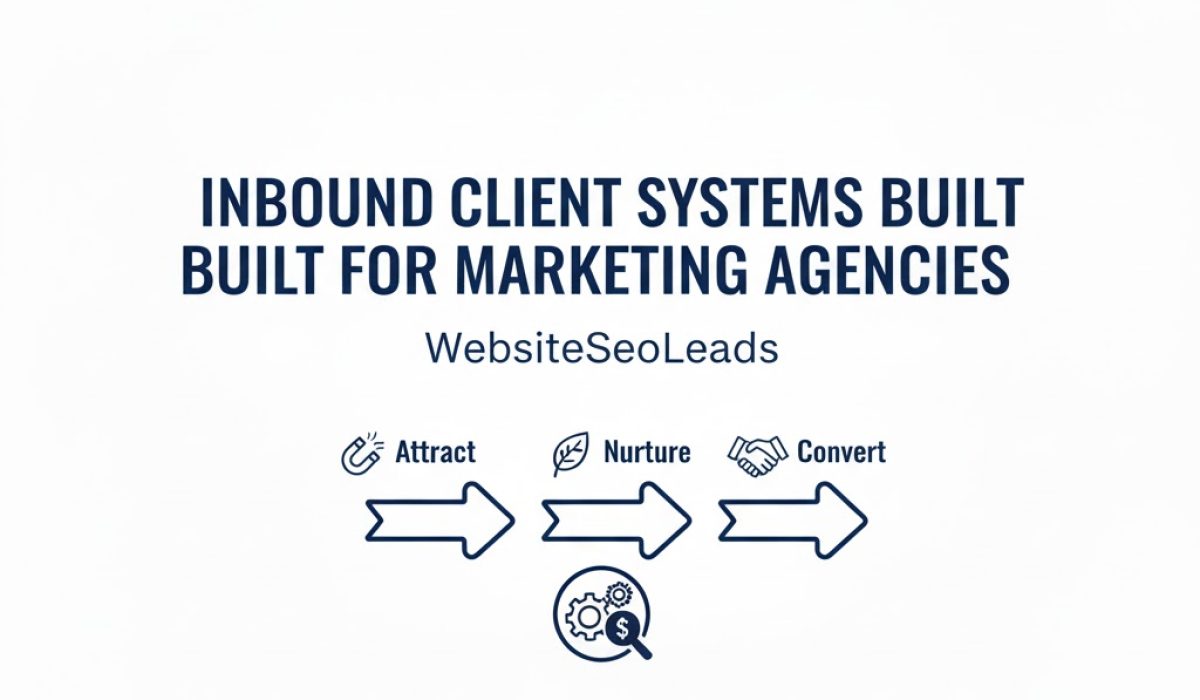
These systems typically combine traffic generation, lead capture, qualification, nurturing, and follow-up into one connected process. The goal is to reduce manual effort while increasing lead quality and conversion rates.
Unlike random lead generation campaigns, inbound systems are designed to work continuously. Once set up correctly, they function as a client acquisition engine that operates in the background of your agency.
Why Marketing Agencies Need Inbound Systems
Marketing agencies are uniquely positioned to benefit from inbound strategies, yet many struggle to implement them for their own growth. Agencies are often busy delivering results for clients while relying on referrals or inconsistent outreach for themselves.
Inbound client systems solve several common agency challenges:
First, they create predictability. Instead of relying on referrals or seasonal demand, agencies can generate a steady flow of qualified inquiries.
Second, they improve lead quality. Inbound prospects usually have higher intent because they are actively searching for solutions rather than being interrupted by a sales pitch.
Third, they reduce sales friction. Prospects who arrive through inbound channels are already educated about the problem and often about your services, making the sales process smoother and shorter.
Finally, inbound systems scale better. Once traffic and automation are in place, increasing volume does not require proportional increases in manual labor.
Core Components of an Effective Inbound Client System
To work effectively, inbound systems must be built on a solid foundation. Each component plays a specific role in guiding prospects from discovery to conversion.
Targeted Visibility
Inbound begins with visibility. Agencies must be present where potential clients are actively searching. This includes search engines, industry-specific platforms, and professional networks.
SEO plays a critical role here. Ranking for service-related queries, problem-based searches, and comparison keywords allows agencies to capture demand that already exists. Content marketing, landing pages, and local optimization all contribute to consistent inbound traffic.
Paid traffic can also support inbound systems when used strategically, especially for competitive services or new agencies building initial momentum.
High-Converting Lead Capture
Traffic alone is not enough. Inbound systems must convert visitors into leads. This requires clear messaging, strong value propositions, and simple conversion paths.
Effective lead capture often includes optimized landing pages, contact forms, consultation requests, or gated resources such as audits or assessments. The focus should be on clarity and relevance rather than overwhelming prospects with options.
The messaging should speak directly to the prospect’s pain points and desired outcomes, positioning the agency as a solution rather than just a service provider.
Lead Qualification and Segmentation
Not every inbound lead is a good fit. Without qualification, agencies risk wasting time on low-budget or mismatched prospects.
Inbound systems should include mechanisms to filter and segment leads based on criteria such as service interest, business size, location, or readiness to buy. This can be achieved through form fields, follow-up questions, or automated workflows.
Qualified leads move faster through the pipeline, while unqualified leads can be nurtured or filtered out without consuming sales resources.
Automated Nurturing and Follow-Up
One of the biggest advantages of inbound systems is automation. Many prospects are not ready to buy immediately, but that does not mean they should be ignored.
Automated email sequences, follow-up reminders, and educational content help keep the agency top of mind while building trust over time. This is especially important for high-value services like SEO, web development, and ongoing marketing retainers.
Automation ensures that no lead is forgotten and that every prospect receives consistent communication regardless of volume.
CRM and Pipeline Management
A centralized CRM is essential for managing inbound leads effectively. It allows agencies to track interactions, monitor pipeline stages, and measure conversion performance.
With proper CRM integration, agencies can see which channels generate the best leads, which campaigns convert most effectively, and where prospects drop off. This data-driven insight allows continuous optimization of the inbound system.
The Role of Specialized Lead Platforms
While some agencies build inbound systems entirely in-house, many accelerate results by using specialized platforms designed for agency lead generation and management.
Platforms like WebsiteSeoLeads help agencies access pre-qualified prospects who are actively looking for services such as SEO, SMM, and web design. When integrated into an inbound framework, such platforms can significantly reduce the time required to build consistent deal flow.
By combining inbound traffic, automation, and curated lead sources, agencies can create a hybrid system that delivers faster and more predictable growth.
Common Mistakes Agencies Make With Inbound Systems
Despite the benefits, inbound systems often fail due to poor execution or unrealistic expectations.
One common mistake is focusing only on traffic without conversion optimization. High traffic volumes mean little if visitors do not take action.
Another mistake is ignoring follow-up. Even inbound leads require timely and structured communication. Delayed responses often result in lost opportunities.
Some agencies also overcomplicate their systems, using too many tools without clear workflows. Simplicity and clarity are often more effective than complex setups.
Finally, inconsistency can undermine inbound efforts. Content, optimization, and follow-up must be maintained over time for sustainable results.
Measuring Success and Scaling the System
Inbound systems should be continuously measured and refined. Key metrics include lead volume, conversion rates, cost per acquisition, and client lifetime value.
As performance improves, agencies can scale by expanding keyword coverage, increasing content production, testing new lead magnets, or adding automation layers. The goal is to strengthen the system rather than replace it.
Agencies that treat inbound as a long-term asset rather than a short-term tactic gain a significant competitive advantage.
Building a Sustainable Growth Engine
Inbound client systems are no longer optional for marketing agencies that want consistent, scalable growth. They provide a way to attract high-intent prospects, reduce reliance on outbound sales, and build a more resilient business model.
When combined with automation, CRM integration, and trusted lead sources like WebsiteSeoLeads, inbound systems become powerful engines that support agency growth year after year.
For agencies willing to invest in structure, strategy, and optimization, inbound client systems offer not just more leads, but better clients and more predictable revenue.